
How The Conscience Is Instructed
Extemporized.
Reconnoiter.
Dulcet.
Apace.
Your Ambleside student probably knows what these words mean. That’s because the child who is read to regularly will be exposed to vastly more words than those who are not (a clear benefit for the practice).
“Words are as wild as rocky peaks. They’re as smooth as a mill pond and as sunny as a day in a meadow. Words are beautiful things,” said the writer Brian Jacques in Leonard S. Marcus’ book, The Wand in the Word: Conversations with Writers of Fantasy.
We quite agree!
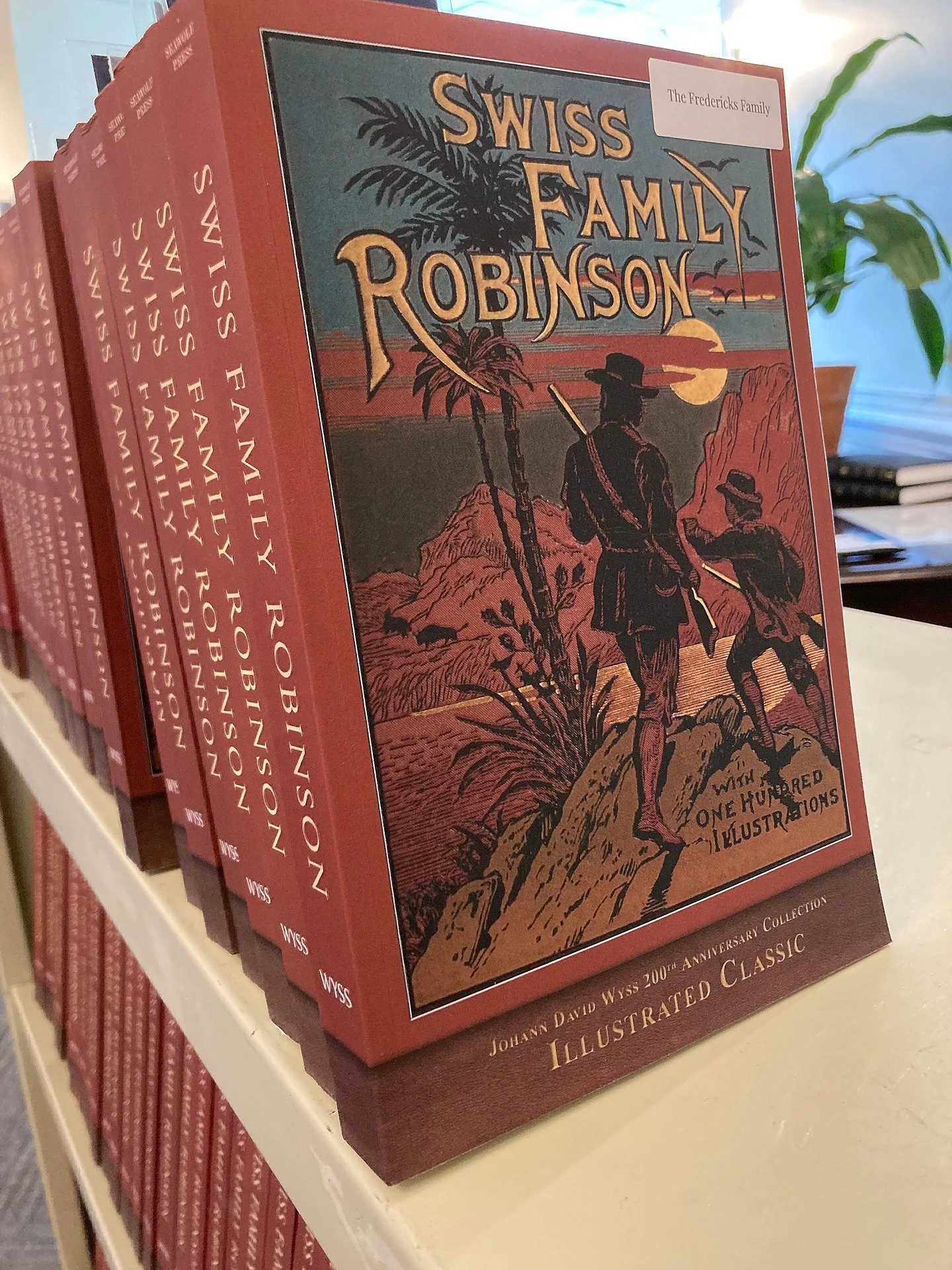
The vocabulary in The Swiss Family Robinson, our Fall Read Aloud selection, is rich and varied as the examples above show. But exposure to a rich vocabulary is not the only benefit of the simple habit of reading aloud.
Charlotte Mason, in her book Ourselves, asserts that for a person to function well and as they ought, their conscience must be instructed. How does one go about this? Long lectures at the feet of experts? A simple “how to” manual? Or the hard way – by personal experience?
It is through what we read that the conscience is instructed, novels being a chief way. Mason called novels “homilies to the wise.” She said that when one reads a novel they should read not merely for the tale but “to learn the meaning of life.” Still she wrote, “The characters in the books we know become our mentors or our warnings; our instructors always.” If this is so, then what can we learn from the characters in The Swiss Family Robinson? Are there mentors or warnings for us in its pages?
It is the father of the Robinson family who narrates the story to us, and it is from him we are instructed. The importance of physical strength is seen early on. “No man can be really courageous and self-reliant without an inward consciousness of physical power and capability.”
Later on in the book we see that it is through the family’s perseverance and hard work that they were able to accomplish all that they did. “Thus day after day brought its own work, and day after day saw that work completed. We had no time to be idle, or to lament our separation from our fellow creatures.”
And finally, to stop, rest, and give thanks. “We greeted each Sunday and its accompanying rest most gratefully, and on that day always, especially thanked God for our continued health and safety.”
Mason wrote, “Literature is full of teaching, by precept and example, concerning the management of our physical nature…the way such teaching should come to us is, here a little and there a little, incidentally from books we read for the interest of the story…” The Swiss Family Robinson is indeed an interesting story, but it also has much to teach – us and our children alike.
Where are you in the book? What lessons have you learned? I’d love to hear!

Gratefully,
Krise Nowak, M.Ed.
Head of School
PS - Do you know other families who would be interested in these ideas? Forward them this email! And let them know about our upcoming Open House on October 22.