
All Because of an Introduction
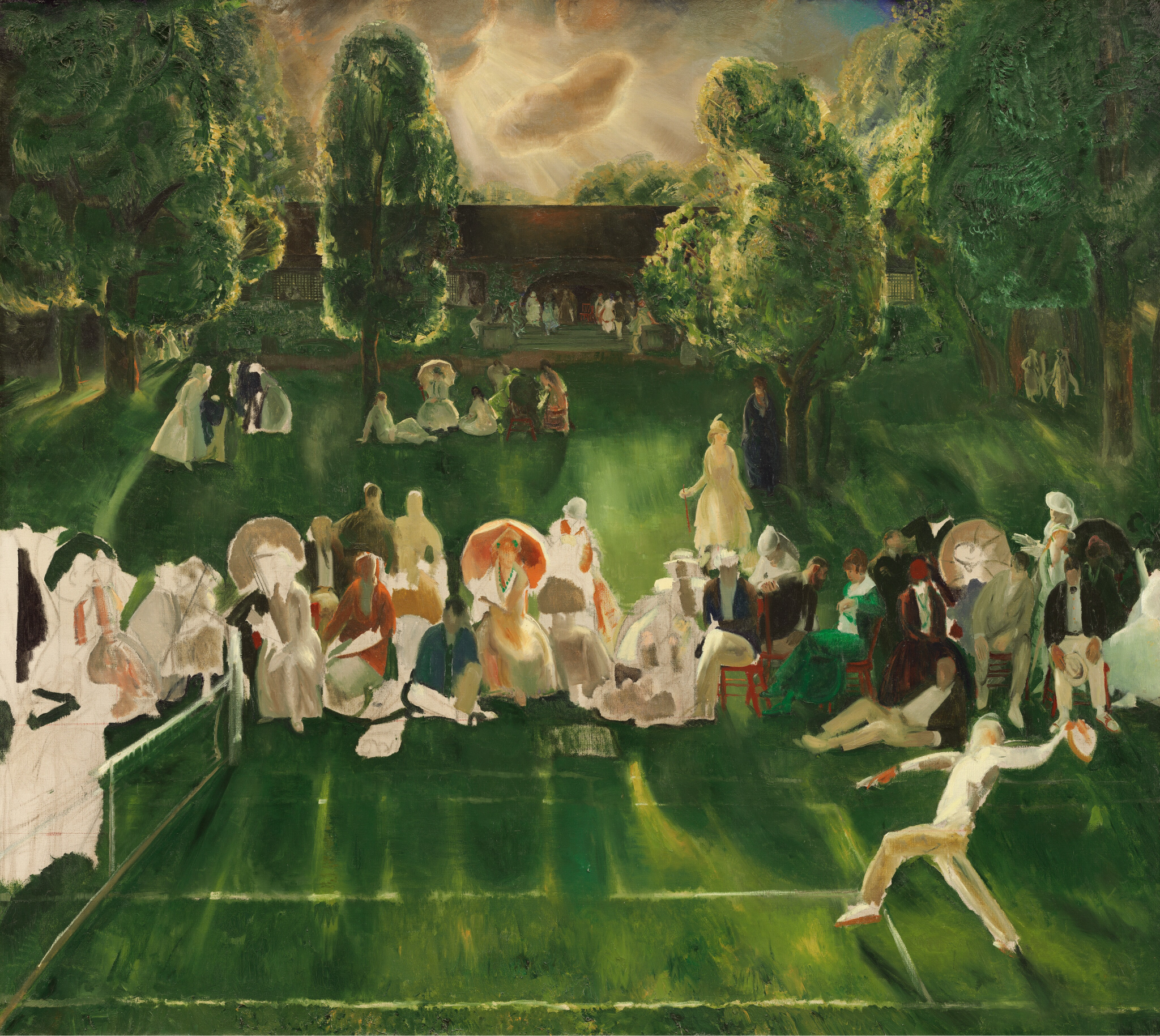
George Bellows, Tennis Tournament, 1920. Oil on canvas.
National Gallery of Art, Washington, Collection of Mr. and Mrs. Paul Mellon.
Dear Parents,
At Back to School Night last month, I shared a few thoughts about one of the great privileges we have at Ambleside: making introductions. Several parents asked about those remarks afterward, so for this month’s letter, I wanted to share an expanded version of them with our whole community.
Some might say that my life changed in the summer of 2023.
My husband and I were in Ambleside, England, for a holiday, doing all the typical Lake District things: visiting Beatrix Potter’s Hill Top, wandering through Wordsworth’s homes, eating Grasmere gingerbread, and, of course, seeking out all things Charlotte Mason—her teacher training college, Scale How, her church, her gravesite.
We also visited pubs. How could you not?
Early in our trip, we followed the guidebook to The Unicorn, Ambleside’s oldest pub. And it was there that the course of my life changed.
Not dramatically. But changed nonetheless.
The place was tiny. Low ceiling. A small bar on the far wall. Packed with people.
And it was completely silent.
We stepped inside and stopped. A few seconds into this Twilight Zone moment, my husband realized what was happening.
The Wimbledon men’s final was playing on a television near the fireplace. Everyone was watching.
Or, more accurately, trying to watch.
We were standing in the way.
On the screen, 20-year-old Carlos Alcaraz was battling 36-year-old Novak Djokovic, who had already won Wimbledon seven times. Five sets. Four hours and forty-two minutes. And when we walked in, they were in the final game, the final few points.
Game. Set. Match. The young Spaniard won his first Wimbledon championship.
That match introduced me to two people:
Carlos and Novak.
And I’ve been hooked ever since.
Before that afternoon, they were just tennis players. Then they had names. And very quickly, they had backstories.
When the trophy ceremony began, I moved closer to the television.
I wanted to hear more.
And in the years since, I have. I’ve gotten up at four in the morning to watch an Australian Open final. I’ve rearranged my day to see a favorite player. I’ve expanded beyond the Grand Slams, thanks in part to the discovery, quite accidentally, that apparently we have the Tennis Channel. And then this summer, I was invited to the DC Open—not just to attend, but to watch from a private suite. I had gone from television tennis enthusiast to professional-tennis-in-person person. Cue John Denver. “Almost heaven…”
All because of an introduction.
That afternoon in a tiny pub, two people who had been strangers to me suddenly had names. And names have a way of inviting us closer. Once I knew their names, I began to notice, to wonder, to want to know more.
That’s often where relationships begin.
I’ve been thinking about that word lately—relationship—because it appears in a place that matters very much to our school: our mission statement.
At Ambleside, we seek to help each child “author a life rich in relationship to God, self, others, ideas, and all of creation.”
A life rich in relationship.
And relationships often begin very simply.
With a name.
Someone says, “I’d like you to meet…”
A person—or an idea, a place, a story, a creature, a piece of music—that was once simply part of the background steps forward. It has a name.
An introduction isn’t a relationship.
But it can be the beginning of one.
It occurred to me that making introductions is a great deal of what we do at Ambleside. Day after day, year after year, we are saying to children: I’d like you to meet someone.
Meet Robert McCloskey and John Philip Sousa.
Winslow Homer and Beethoven. Squanto and George Washington Carver.
Meet Claude Monet and Laura Ingalls Wilder—and three new friends named Wilbur, Charlotte, and Fern.
But, of course, not all introductions are to people.
Meet the mighty dinosaurs. Crochet. Cursive handwriting.
Look up and discover meteorology. Listen carefully and discover that the bird outside your window has a name.
Meet Rembrandt and the March sisters. Nathaniel Bowditch and Leonardo da Vinci. William Wordsworth and Matisse.
Meet human anatomy. Wood carving. A mathematical problem that seems impossible until, through patient effort, you discover that your own mind can solve it.
And along the way, meet a man named William Shakespeare.
Our students don’t simply learn that Shakespeare was an English playwright who lived hundreds of years ago. They keep encountering him.
They read his plays. They perform them. They study and memorize his sonnets. They speak his words aloud.
Just a few months ago, Carrigan Fischer was one of our eighth graders. Now she is a freshman in high school and taking drama. Her teacher announced that their fall play would be A Midsummer Night’s Dream.
Carrigan looked around and realized she was the only student in the room who knew anything about it.
Of course she did.
Shakespeare wasn’t a stranger.
She had met him before.
And now she has been cast in the play herself.
That is what we hope happens with so many of these introductions.
We don’t know which child will hear Beethoven and still be listening to him at seventy.
We don’t know which child will learn the name of a bird and never again walk through the woods without listening for its song.
We don’t know which character in a book might become a companion for life.
We don’t know which idea encountered at eight or ten or twelve will still be working in that person at forty.
We can’t know.
But we can make the introduction.
Charlotte Mason had a wonderful image for the kind of life all of these relationships make possible. She wrote:
“‘Thou hast set my feet in a large room’ should be the glad cry of every intelligent soul.… We should be in touch wherever we go, whatever we hear, whatever we see, with some manner of vital interests.”
That is what we want for our children. A large room. A world populated by people and places and ideas and stories and music and numbers and creatures and beauty that they have begun to know.
The world becomes less anonymous.
A painting has a painter. A symphony has a composer. A bird has a name. A constellation has a story. A historical event is populated by actual people whose choices mattered. A poem has words worth returning to.
The world becomes filled with what Mason called vital interests—things worthy of our attention, our thought, and our affection.
Every introduction makes the room a little larger.
And this, I think, is one of the great gifts of a living education. We are not simply giving children information about the world. We are helping them become acquainted with it.
Knowledge becomes more than the accumulation of facts. It becomes a means of relationship.
Which brings me back to our mission:
A life rich in relationship to God, self, others, ideas, and all of creation.
Many of the most important names our children know were given to them long before they came through our doors.
Abraham. Moses. Ruth. David. Daniel.
And above all, Jesus.
For many of our children, those introductions happened first at home and at church. Our privilege as a school is to come alongside parents—to return with children again and again to Scripture and, most importantly, to Christ.
Because our aim is not ultimately to produce extraordinarily cultured children who can identify a Monet, quote Shakespeare, name a bird, and recognize Beethoven.
Those things are wonderful.
But that isn’t the end.
Charlotte Mason writes:
“The knowledge of God is the principal knowledge and the chief end of education.”
The chief end.
The large room belongs to God.
The beauty our children encounter is His.
The truth they discover is His.
The people they meet bear His image.
The creation they learn to attend to is His creation.
And above all the other relationships we hope will grow during these years, we pray that their relationship with God Himself will deepen.
That they will not merely know more things about Him.
That they will know Him.
Which brings me back to a tiny pub in Ambleside.
That seemingly chance encounter with a tennis match playing on a television in an English pub has become something far greater than I could have imagined that afternoon. It has become a great interest and a great source of enjoyment in my life. And I count it as a gift from above.
In fact, I am currently making plans for a new three-season room at my house that I have dubbed the Crystal Palace—which will be used chiefly for watching…
you guessed it…
tennis.
All because of an introduction.
So here’s to the introductions we make for our children—and to all that God may do with them long after the introduction has been made.