
On Christ the Solid Rock
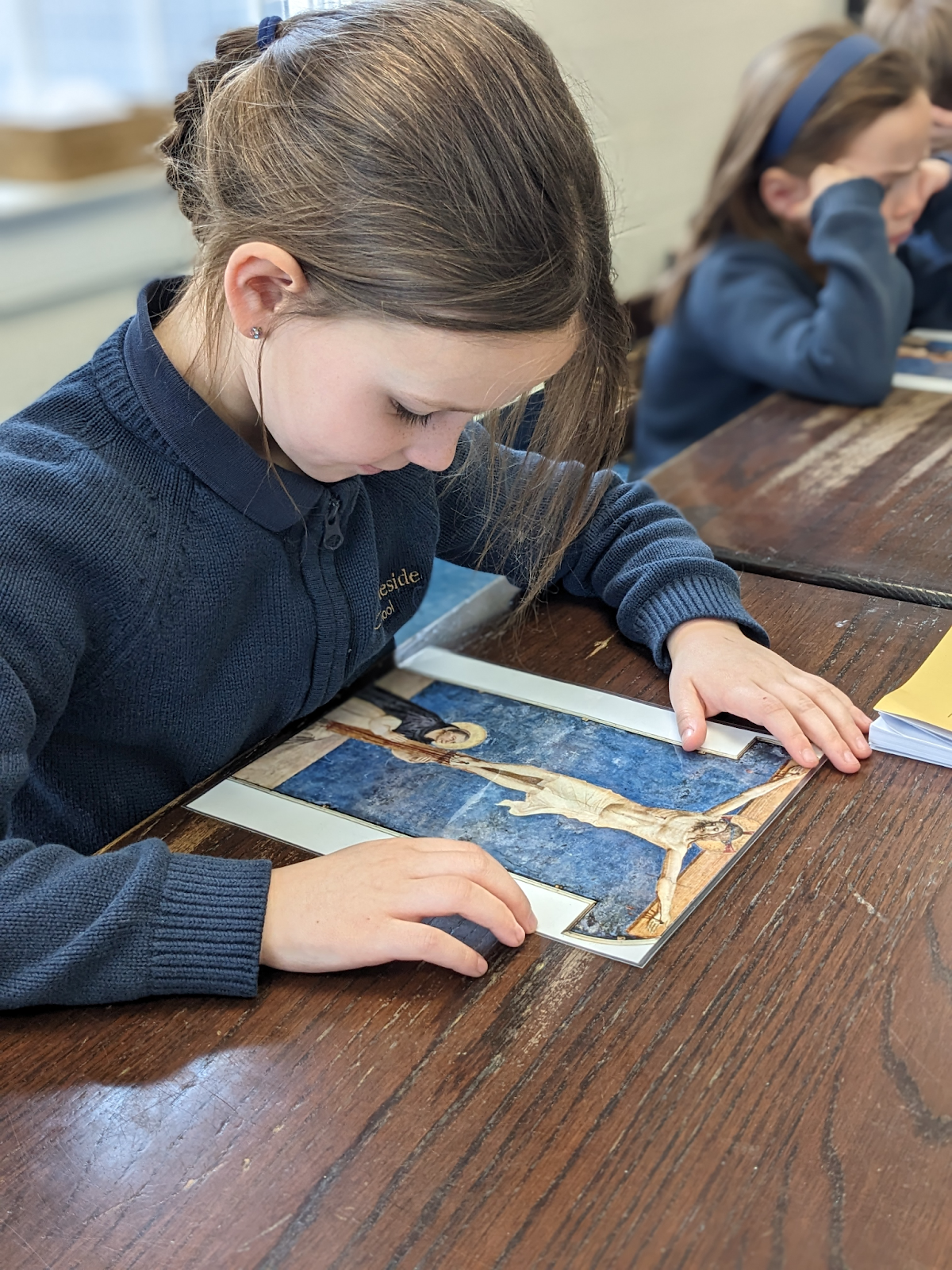
A student studying St. Dominic at the Cross of Christ by Fra Angelico during a weekly Picture Study lesson
Dear Parents,
This time of year has me thinking about our daily, weekly, and yearly rhythms — the steady practices that point both ourselves and our students to Jesus.
Beginning on Ash Wednesday, we replace the Pledge of Allegiance with a Lenten litany drawn from Psalm 51:
Create in me a clean heart, O Lord —
And renew a right spirit within me.
We also shift at this time of year to favorite hymns, The Old Rugged Cross and The Solid Rock, to name a few. The students beautifully belt out the refrain of the latter:
On Christ, the solid Rock, I stand;
All other ground is sinking sand;
All other ground is sinking sand.
There is something profoundly formative about singing those words together, not once, but again and again.
These rhythms, daily, weekly, yearly, shape us.
They remind us who we are and whose we are.
And they quietly answer the deeper question beneath our work:
Who are our children becoming?
At Ambleside, this question matters more to us than anything else. Our aim is not simply that students know about Jesus, but that they become His followers and, over time, His friends.
That formation happens steadily.
Each morning we gather in assembly. We sing a hymn. We pray. These practices are not ornamental additions to our school day; they are formative habits.
From there, students return to their classrooms for the study of God’s Word.
In Kindergarten, students begin at the beginning: Creation, Abraham, Joseph, Moses, the Red Sea, the Ten Commandments, the Tabernacle. Alongside these, they hear of the Angel visiting Mary, the calling of the disciples, the Wedding at Cana, Pentecost, and the courage of the early Church. Even at five and six years old, they are learning that Scripture is one unfolding story and that Jesus stands at its center.
In First Grade, that story widens. Students walk through Joshua and the Judges, Ruth, Samuel, David, and Solomon. They follow Christ through His ministry, parables, Passion, and Resurrection, and then continue into Acts, tracing Paul’s journeys all the way to Rome and John on Patmos.
From Second through Eighth Grade, the scope deepens and matures: Genesis and Mark; Exodus and Luke; Joshua and Acts; Samuel and Matthew; Kings and Luke again with older eyes; Nehemiah and Esther alongside Paul’s epistles; Job and Daniel before entering John and James. Across these years, the Psalms shape their prayer through Lectio Divina. Students slow down. They listen. They attend. They respond.
They are not simply reading the Word.
They are dwelling in it — being nourished and formed.
And each Friday, we gather again in Chapel, hearing a recitation from one class, often drawn from Scripture, listening to a speaker, worshiping together, and ending as parents surround the reciting class in prayer.
Hours in His Presence
It is easy to underestimate what happens in small, repeated moments.
Each week, your children spend nearly two hours reading Scripture, narrating it, discussing it, praying through it, and gathering in Chapel to worship together. Over the course of a school year, that becomes more than 60 hours in the Word.
Over nine years at Ambleside, that is more than 500 hours in Scripture — 500 hours in the presence of God’s Word.
Five hundred hours hearing of His faithfulness.
Five hundred hours watching Christ move toward the broken.
Five hundred hours listening to psalms of lament and praise.
Five hundred hours learning that repentance is possible and mercy is real.
Formation rarely announces itself. It accumulates — hymn by hymn, story by story, year by year.
And so when I hear our students sing,
On Christ, the solid Rock, I stand;
All other ground is sinking sand…
I am reminded that this is our hope.
That after hundreds of hours in His Word, after years of steady rhythms and shared worship, when shifting ground comes — as it always does — they will know where to stand.
And that, above all else, is the education we are seeking to give them.
For the children’s sake,
Krise